

 English
 Deutsch
 عربى
عربىA standard hook holds things. A safety hook holds things and makes it genuinely difficult for them to come off by accident. That distinction sounds small until something fails mid-lift or a climber's equipment detaches at the wrong moment. The locking or spring-loaded gate that closes the hook's opening is not a complicated piece of engineering, but it has made the safety hook a fixture in industries where an open hook is not an acceptable risk.
The snap hook is probably the version most people have handled without thinking much about it — a spring-loaded gate that closes on its own when released, opens with a push. It handles fast, repeated connections reasonably well, which is why it shows up on lanyards, luggage straps, dog leashes, and dozens of other everyday applications. The limitation is that the gate can be pushed open by contact with another surface, a rope, or a piece of equipment if the geometry lines up the wrong way. In low-stakes settings that rarely matters. In others, it matters a great deal.
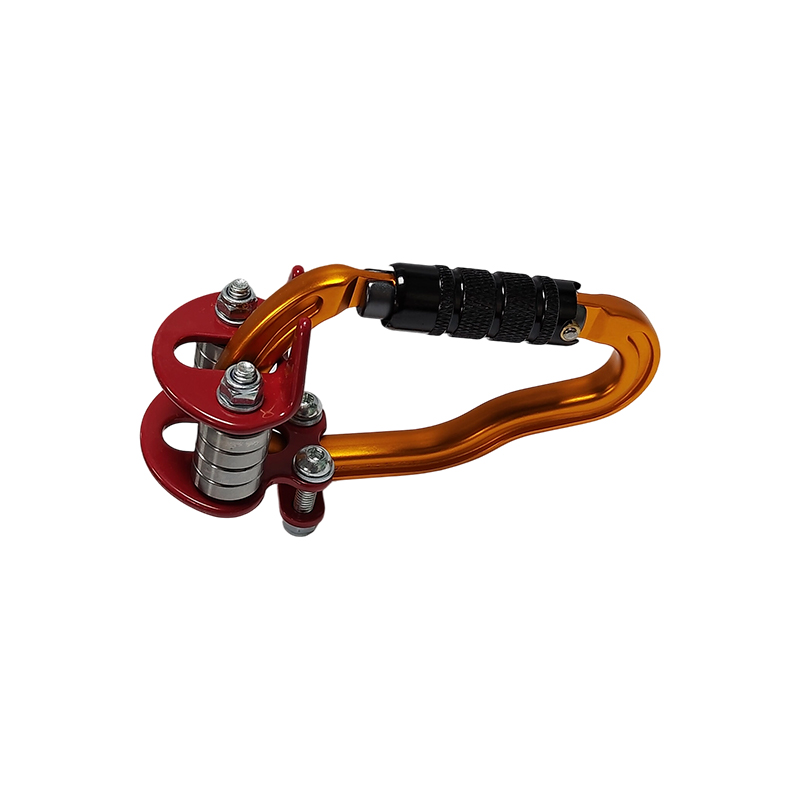
Locking safety hooks address that gap by adding a second step to the release sequence. A rotating sleeve, a screw collar, or a push-and-twist mechanism sits over the gate and has to be moved before the gate will open at all. The result is a hook that will not accidentally disengage when it bumps against a wall, gets tangled with other hardware, or carries a load that shifts direction. Climbing carabiners, fall arrest connectors, and rescue rigging use this format for that reason.
Material choice tends to follow the environment and load requirements fairly closely:
- Forged steel — the standard for heavy industrial lifting and crane rigging, where load ratings reach several tonnes and the hook needs to survive rough handling over a long service life
- Stainless steel — chosen for marine hardware, food processing lines, and chemical plant environments where corrosion is the primary concern rather than raw strength
- Aluminum alloy — common in climbing and personal fall protection equipment, where keeping weight down over a full day of use affects performance in ways that a desk job does not
- Stamped steel — found in lighter commercial and consumer products, adequate for lower loads and generally less expensive to produce
Load rating comes up early in any serious selection process, and it involves two figures that are easy to conflate. Working load limit is the number the hook is designed to carry under normal use. Breaking strength is the point at which the hook actually fails — usually several times higher, which accounts for shock loading, dynamic forces, and the reality that conditions in the field rarely match a controlled test. The gap between the two is intentional and worth understanding before assuming a hook is overspecified.
Gate strength deserves more attention than it typically gets. The hook body and the gate are separate components with separate load ratings, and in a fall arrest or dynamic rigging situation, forces do not always travel in the direction the hook is aligned. A gate rated significantly lower than the body creates a weak point that the overall load rating does not reflect. Published gate strength figures, when available, should be compared against body strength rather than ignored.
Gate opening width is a more practical issue than it sounds. A hook with a narrow opening will not accept a thick shackle, a wide anchor ring, or a double-looped webbing connection regardless of what its load rating says. Mixing hardware from different manufacturers or repurposing a hook from one application to another is where this catches people off guard.
None of this complexity changes the basic point. A safety hook is a retention device, and its value is entirely in how reliably it retains under the specific conditions it was chosen for.






 3rd Floor, Comprehensive Building, No. 1 Huimin Road, Nanmingshan Street, Liandu District, Lishui City, Zhejiang Province
 +86 15325130332
